Case study: 118 hours a month of marking invoices, handed to an agent. What changed at Aquator Transilvania
Client: Aquator Transilvania
Industry: manufacturing and sales of water filtration systems
118 hours a month
That is how much of a full-time accountant's time at Aquator Transilvania went into marking invoices as paid. Roughly 70% of his working month, out of about 168 hours. The remaining 30% had to cover the accounting for a company that sells through several channels and grows every year.
Today, an agent takes the payment settlement reports from couriers and marketplaces and closes the invoices in the accounting software, hundreds per minute. The accountant checks the result. It takes him five minutes at most.
Here is how we got there and, more importantly, what it means for a company.
The case study at a glance
The image below sums up the whole process: the problem we started from, the solution we built for Aquator Transilvania and the concrete impact on time and costs.
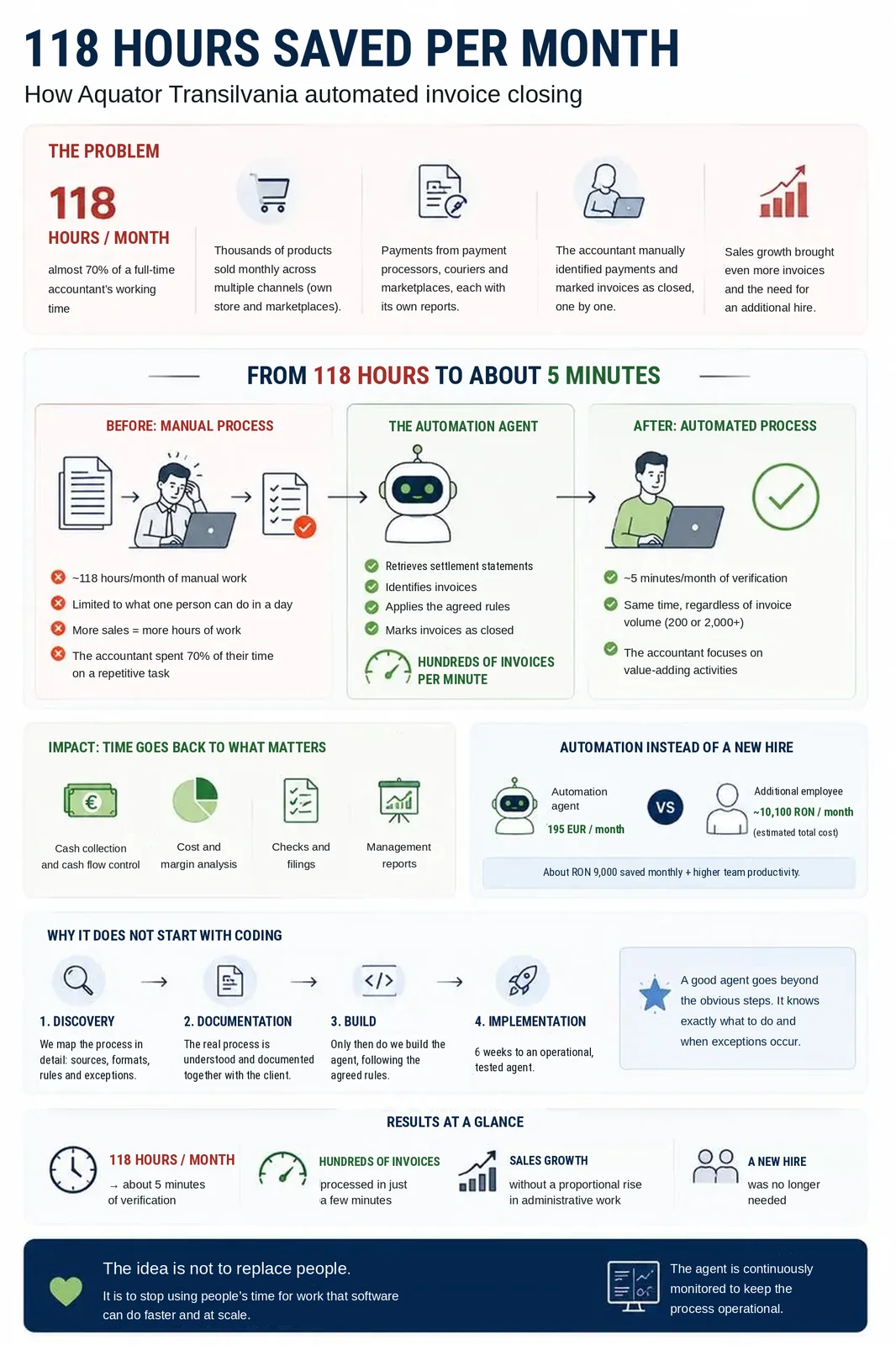
Now for the details: how marking invoices came to take up 70% of the accountant's time, why a new hire wouldn't have solved the problem and how we built the agent that now processes hundreds of invoices per minute.
Who Aquator Transilvania is
The Aquator filter was invented in the '90s by Adrian Costache, a chemist from Buzău. In 1994 it won the gold medal at the Brussels International Exhibition of Inventions for its porous block of activated carbon and silver, which filters water without stripping out the minerals.
Aquator Transilvania, based in Florești, Cluj County, brought this filter back into production. It modernized manufacturing and, according to its managing director, now produces thousands of filters a month, sold through its own online store and through marketplaces.
Thousands of filters sold every month, across several channels, means hundreds of invoices every month. And the settlement reports for those payments arrive in different formats, from payment processors, from courier companies, from each marketplace. Someone has to match them all up and correctly mark in the accounting software what has been paid.
70% of an accountant's month, on a task that requires no decisions
Once orders were paid, the accountant received reports from payment processors, courier companies and marketplaces, each in a different format. Based on them, he marked every invoice as closed. Open the report, find the invoice, confirm the money came in, mark it. Hundreds of times a month, as thousands of orders produced just as many invoices.
Marking invoices is part of accounting, but it's routine work that always follows the same steps and calls for no professional judgment.
The other 30% of the month had to cover the part where an accountant's expertise brings real value to a company: chasing unpaid invoices and late-paying customers, managing cash flow so the company pays its suppliers and taxes on time, analyzing costs and margins, preparing the reports management relies on to make decisions. These are just a few of the tasks the company's financial health depends on, from a much longer list. Marking invoices isn't one of them.
“Our accountant couldn't keep up. She had much more important things to do and was constantly
stuck marking these invoices.”
- Sergiu Maja, managing director, Aquator Transilvania
Aquator keeps investing, and sales grow every year. Each increase brings more invoices with it. A task that eats up this much time and grows along with the company shouldn't sit on one person's desk, done by hand, invoice by invoice. Otherwise you end up exactly where Aquator was: the more the company sold, the less time was left to keep an eye on its financial data.
The alternative: another hire?
In a situation like this, almost every business owner's first thought is to hire someone else. It seems like the logical step when the volume is more than one person can handle.
An accountant is paid (and ideally should be) for the things a digital tool can't do: interpret the numbers, figure out where margin is being lost and which costs need a second look, recommend a better tax structure, prepare the reports management uses to make investment decisions.
These things take an understanding of context and professional judgment.
If a second accountant had also ended up marking invoices 70% of the month, Aquator would have been paying two qualified people to spend most of their time on a repetitive, time-consuming task that can be automated and has no business landing on someone with valuable expertise. The same work, split between two people, at double the cost, permanently. And at next year's volume, a third person would probably have followed.
When you need a professional's judgment and expertise, you hire. When you have a process that repeats the same way hundreds of times a month, with fixed rules, you automate it.
What we built for Aquator Transilvania: the invoice-closing agent
The agent takes the payment settlement reports from couriers and marketplaces, finds the invoices in the accounting software and marks them as closed, following fixed rules agreed at the start of the project. It processes hundreds of invoices per minute.
That speed means something concrete for the company: the number of orders can grow as much as it wants, and processing time stays about the same. Before, doubling sales meant nearly doubling the hours spent marking invoices. Now it's the same few minutes of run time, whether 200 or 2,000 invoices come in.
The accountant no longer marks anything. He looks over what the agent did and confirms everything is in order, in five minutes at most. The nearly 118 hours left over go back into reviews, tax filings and reports for management.
Implementation time: 6 weeks. Tier: Plus (see tier details).
The discovery stage: mapping the process before writing any code
You don't build an agent that runs this cleanly by jumping straight into code. It all starts with an analysis stage we call discovery: the initial conversation where we get to understand the company's process and map it in detail, step by step.
An agent does exactly what it was built to do, nothing more and nothing less. If the process is only half understood, it will handle the usual orders correctly and trip over the ones nobody discussed: an unexpected invoice type, a channel that sends data in a different format, an exception to the rule that nobody mentioned. Every situation left out of the initial conversation later turns into an error someone has to fix.
That's why we map the process as it actually happens, not as the internal procedure assumes it does. We go through every step, every exception, every special case.
At the end of this stage, we document the entire process and include it in the contract. That way, before the build starts, both sides know exactly what the agent will do: what it takes in, which rules it applies, how it handles each exception. No room for interpretation and no surprises along the way.
What changed, in practice
| Before | Now | |
|---|---|---|
| Marking invoices | ~118 hours a month of manual work (70% of a full-time employee's time) | ~5 minutes of review |
| Processing capacity | Limited by how much one person could get through in a day | Hundreds of invoices per minute |
| Effect of growing sales | More orders meant more hours of manual work | More orders, same processing time |
| The accountant's workload | 70% marking invoices, 30% accounting that matters | ~100% of the time recovered, just 5 minutes checking the agent's work |
| The extra hire | Was the next step | No longer needed |
What it's worth, in numbers
A case study without numbers is just a story, so let's put this in lei. Aquator didn't share its salaries with us and we didn't ask, so we're using public data to get an order of magnitude.
The money: a hire avoided
The real alternative the company had in mind was a second employee. At the national average gross monthly wage for March 2026, 9,902 RON (INS data), an employee in this position costs the company, including contributions, around 10,100 RON a month.
The agent that took over that work falls, in Aquator's case, into the Plus tier, with a monthly subscription of 195 EUR, about 975 RON. Compared with a second salary, the company pays almost 9,000 RON less every month for the same result: invoices closed correctly and on time.
On top of the subscription there's an initial fee, paid once (consulting, process mapping, building and integrating the agent, training). With a cost gap that large compared to a new hire, the fee pays for itself in roughly the first half of the first month.
The value: 118 hours of expertise recovered
Here the gain is a better return on someone you already pay, since that person was already on the payroll. The 118 hours that used to go into marking invoices now go back into the work the accountant was hired for in the first place: cost analysis, keeping track of incoming payments, the reports management uses to make decisions. Same person, same salary, but their time goes into what brings value to the company instead of mechanical execution.
A note on the tier: for Aquator, the complexity of the integrations placed the agent in the Plus tier. In most cases, an agent of this kind fits into the Start tier (135 EUR monthly subscription, about 675 RON), depending on the number of sources and integrations. The conclusion stays the same: the agent's monthly cost is a fraction of what a new hire costs.
What the client says
“Thank you, Cicada Technologies, for an excellent collaboration! The solution you implemented
automated a process that used to take up a great deal of our time, bringing a major boost in
efficiency and organization. We appreciated your professionalism, responsiveness and openness in
finding the best solutions for our needs, and we look forward to the next implementation!”
- Sergiu Maja, managing director, Aquator Transilvania
Who this kind of solution is for
Maybe Aquator's story sounds familiar. It doesn't matter whether you sell water filters or something else entirely; the pattern repeats from one company to the next. For example:
- You sell through several channels, and each one produces invoices and reports that land, in different formats, on someone's desk at your company;
- You have a qualified person you pay accordingly, but who spends a good chunk of the month on a repetitive task that involves no decisions;
- You're thinking about hiring to keep up with the volume, but you're not sure what the new person would actually do the rest of the time;
- Your company produces and sells more and more, but the administrative side hasn't kept pace with that growth.
If any of this sounds like you, an automation agent would take repetitive, manual, time-consuming work off your company's plate and free your people for the tasks that matter, the ones that bring value.
Where to start
It all starts with a consultation call where we learn how you work. Together we look at your needs, at where time or money is being lost in your current processes and at what could be automated. By the end, you have a fairly concrete picture of the opportunities, without having committed to anything. If none of it makes sense for you, you've lost a conversation, not an investment.
If you decide to move forward, next comes the discovery stage. This is where we map the process in detail, step by step, down to the last exception: where the data comes from, in what format, which rules apply, what happens in the less common cases. It's the part that asks the most attention from both of us, and it decides whether the agent will then run without anyone stepping in.
Throughout the project you work with people, not a contact form. You have a dedicated account manager you can call directly when you have a question, and a team that knows your process. Once the agent is live, we keep monitoring it through our platform, where you can also see how it's working at any time. You don't have to do anything. We make sure it keeps working correctly after rollout, because that's exactly our job.
If you want to see what could be automated at your company, fill in the form with a few details and we'll get back to you as soon as possible.
See also how we automated Aquator's customer communication: the agent that sends filter replacement reminders.
