What an employee who spends 75% of their time on repetitive work really costs you
Think of the best person in your company. The one you rely on, the one who was hard to find and whom you'd hate to lose. Now ask yourself, honestly, how much of their day goes into the work you actually hired them for, and how much goes into things anyone could do with a bit of training.
A financial analyst spends, on average, only a quarter of their time on the analysis they were hired to do. The other three quarters go into gathering data, cleaning up spreadsheets, matching amounts in the accounting software, or moving numbers from one place to another. The figure comes from a study by the Association for Financial Professionals, run together with APQC, of more than 430 finance professionals.
The percentage itself isn't the biggest problem. The fact that it has stayed the same for ten years is. A whole decade of new software, digitalization and promises that technology would fix everything, and the ratio between valuable work and routine work hasn't moved. This is not going to fix itself.
And it's not just a problem for accountants or financial analysts.
The same pattern in every corner of the company
Take a salesperson. You hired them for something few people do well: figure out what a customer really wants, handle an objection and close a deal. They're probably among the most expensive people in the company, because they bring in money directly. How much of their week do they actually spend doing that?
28%. That's how much time a sales rep spends actually selling, according to Salesforce's State of Sales report. The rest goes into updating the CRM, looking up information, reports and meetings. In a five-day week, your salesperson sells for about a day and a half. The other three and a half days go to something else.
Look closely and it's almost absurd. The systems salespeople feed all that data into, the CRMs, weren't built to help them sell. They were built to give the manager reports. So after every conversation with a customer, the salesperson stops for 10-15 minutes to enter the data into the system, and during that time they're not selling.
Keep walking through the company and the pattern repeats.
The HR person, who should be handling hiring, people and company culture, spends a good part of the month answering the same five questions dozens of times: how many vacation days do I have left, when does payday hit, what's the procedure for this. The same answers, over and over.
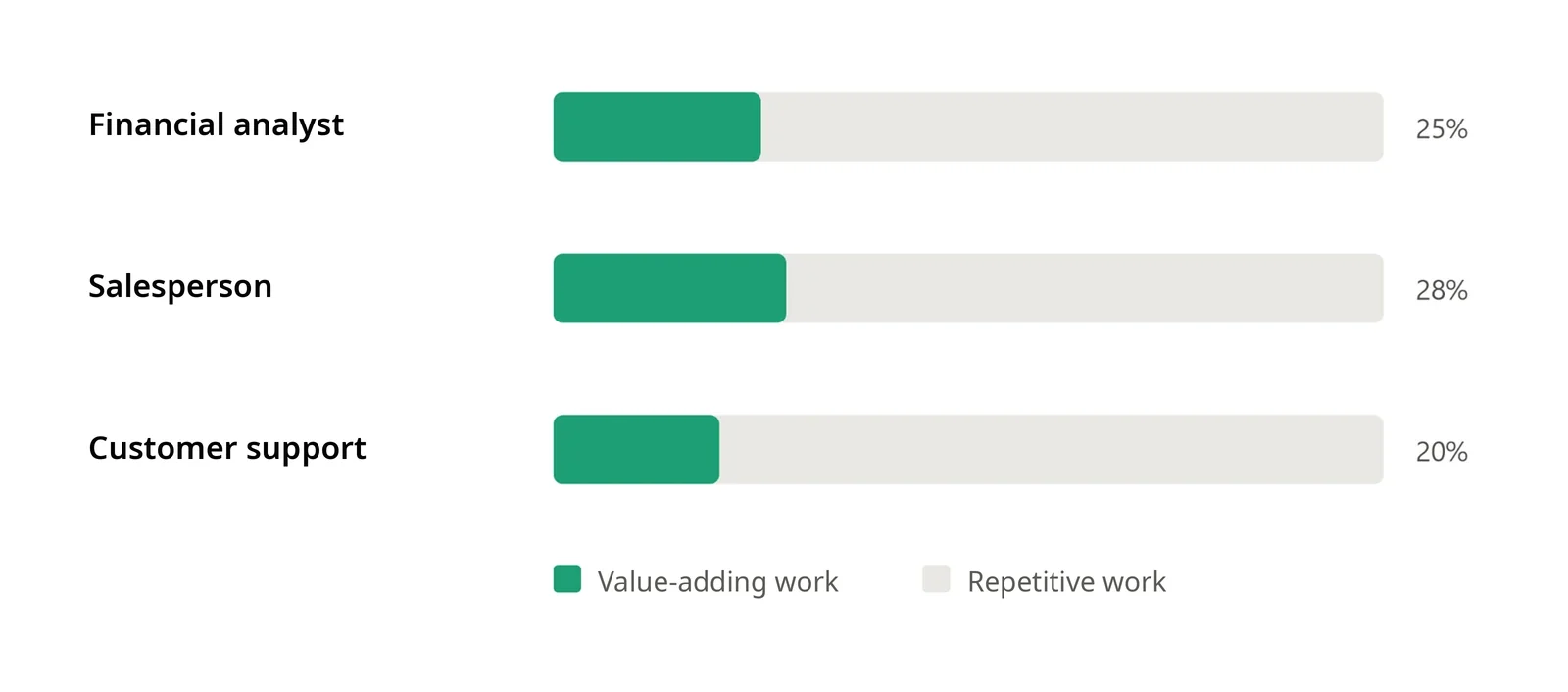
The support person, whom you'd want available for the difficult customer or the delicate problem, spends the day on questions that repeat endlessly. Customer service studies show that up to 80% of the questions that reach an agent are repetitive: where's my order, how do I reset my password, what's the return policy. Four out of five conversations need no judgment, no empathy and no experience. Just an answer the person has already given a hundred times.
You hired each of them for their expertise, experience and skills. And each of them spends most of the day without needing any of it.
What you're actually paying for when you pay a salary
When you hire a skilled person, you're not buying hours. You're buying what they can do in those hours that someone else can't.
A good accountant tells you in February that you won't be able to cover payroll in April, while you still have time to do something about it. A good salesperson knows when to push and when to back off so they don't lose the customer. An experienced support person calms down an angry customer a beginner would lose. That's what you're paying for, and it usually isn't cheap.
Now run the numbers for your company.
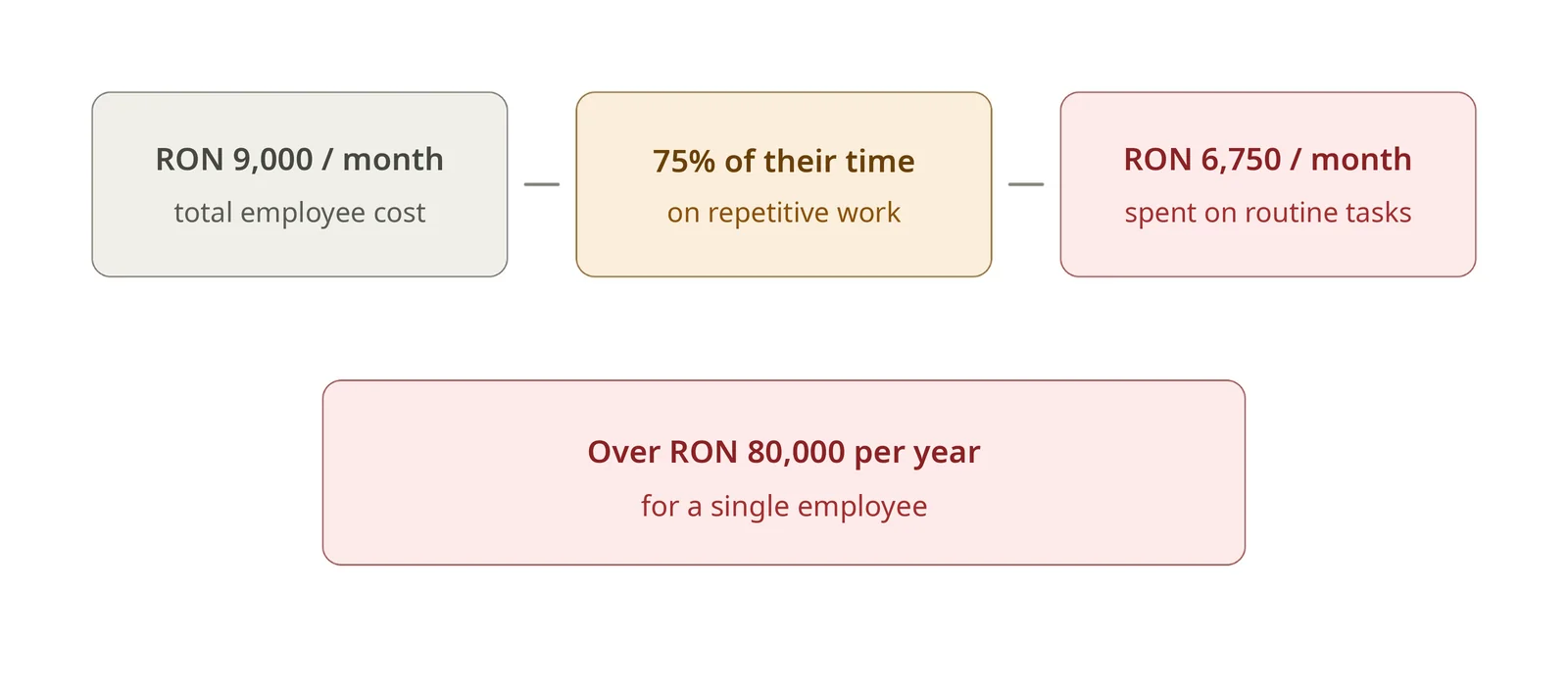
A skilled employee costs you, with salary and payroll contributions, somewhere between 8,000 and 12,000 RON a month, often more. Say 9,000, to stay conservative. If three quarters of their time goes into repetitive work that requires none of the qualities you hired them for, then every month you're throwing away around 6,750 RON on tasks anyone could do. Over 80,000 RON a year. For one person.
You're paying specialist rates for trainee work. And you don't see it anywhere, because it doesn't show up on any invoice and nobody cuts it from a budget. It's hidden in the salary you pay anyway, month after month, year after year.
The cost almost nobody counts: the output is worse, too
So far we've talked about wasted time. But there's something worse that few people factor in.
Manual work doesn't just eat time. It also produces weaker results.
When someone types in hundreds of rows by hand, mistakes happen. A number copied wrong, an amount in the wrong column, a field left blank. Sales studies show that data entered manually into a CRM is often incomplete or unreliable, to the point that decisions based on it rest on shaky ground. So you're paying a skilled person to do work below their level and, on top of that, you get a result you can't fully trust.
You lose twice. First, the hours the person spends entering the data. Second, the hours someone else spends checking what they entered and fixing the mistakes. Routine work doesn't need their experience, and it also creates work for someone else later on, when an error comes to light.
The cost you really don't see: your good people leave
Now we get to the most expensive and least obvious part.
At first, a good employee does the routine work without complaining. After a few months you notice they're late with the report, that you have to remind them of things they used to do on their own. And when another company makes them an offer, they don't think about it for long, because there's nothing to keep them.
The surest way to kill a skilled person's interest is to put them on routine work. And it shows in the numbers.
Research shows that teams with disengaged employees have up to 43% higher turnover. And when a good person leaves, it costs you more than you think. The same research shows that replacing them costs between half and twice their annual salary, counting recruiting, time spent on interviews, training, and the months until the new hire reaches the level of the one who left.
Now put the whole chain together, because this is where the real cost is.
You hire a good person. You pay them well. You have them spend most of their time on repetitive, manual, frustrating tasks. Because of that, they lose motivation. Once they're unmotivated, they're 43% more likely to leave. And when they leave, you pay another half to double their salary to replace them, and then you start over with someone else, whom you'll most likely put on the same routine work.
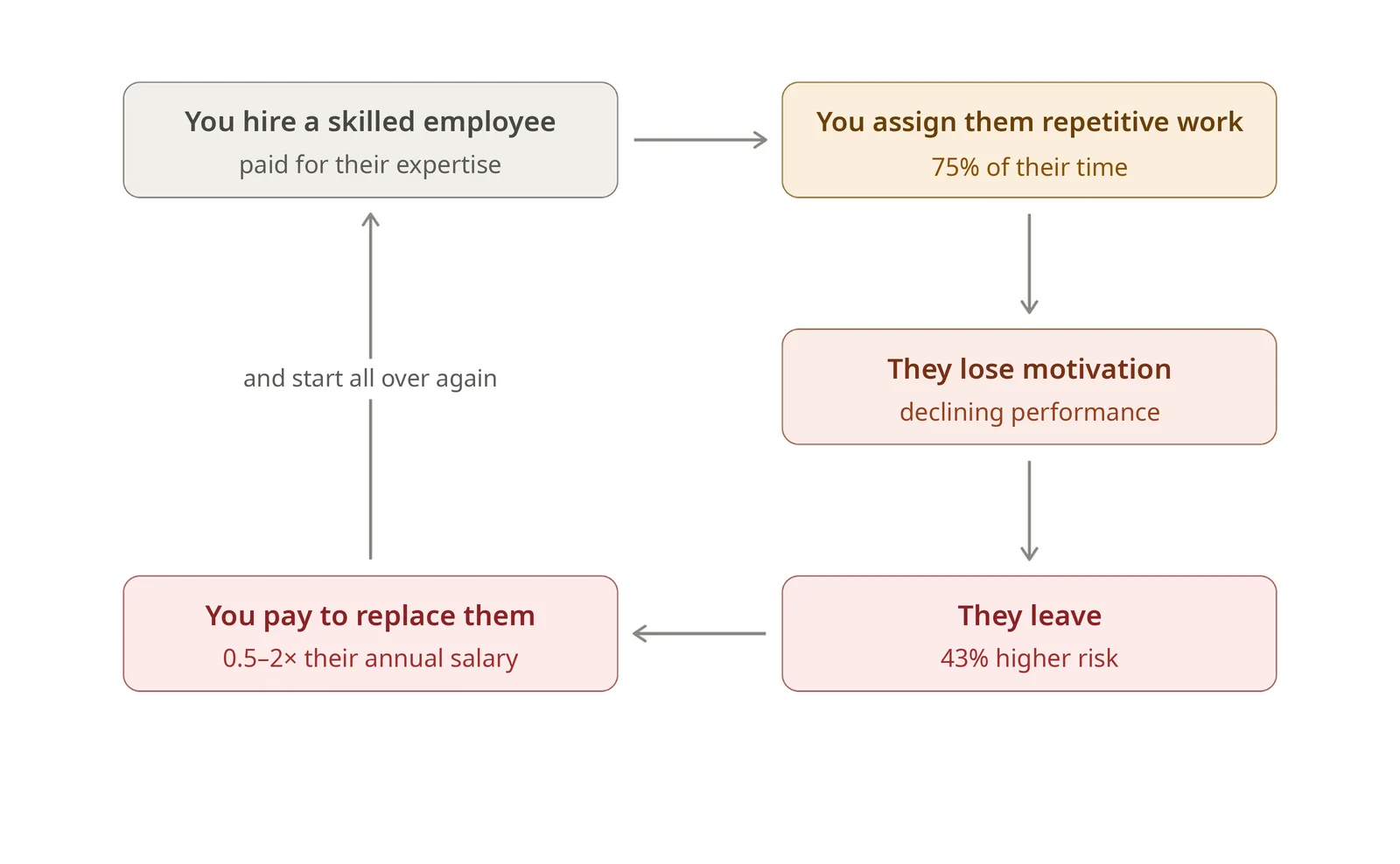
You pay twice, then you risk paying a third time. All because a skilled person was kept busy with something that didn't need them.
If you want to see what repetitive work is taking up your people's time right now, the first conversation with a Cicada specialist is free and comes with no commitment.
The reflex that seems logical and makes the problem worse

When the workload grows and people can't keep up, every business owner's first thought is simple: I'll hire someone else.
It's a natural reaction. But think about what actually happens. If the new person also ends up spending most of their time on the same mechanical work, you haven't solved anything. You've doubled the cost of the problem. Now you're paying two good people to do mostly routine tasks. And a year from now, when the workload grows again, you'll have the same conversation, just starting from a higher cost.
Hiring is the right answer when the company really needs more expertise, more experience, someone skilled to make decisions. It's the wrong answer when the actual problem is that the people you already have are buried in routine work that could be automated.
Only 12.5% of organizations manage to get their finance people above the threshold of 40% of their time spent on valuable work. The rest, almost nine out of ten, stay stuck in the same pattern year after year, no matter how good their intentions. Good intentions aren't enough. You have to change who does the routine work.
The alternative: free up your people instead of replacing them
The routine work that takes up most of your people's day doesn't have to be done by them.
Pulling data from several sources, matching it up, moving it from one system to another, answering the same question for the hundredth time - all of it follows clear rules and repeats the same way every time. None of it requires a decision. It's exactly the kind of work an automation agent built around your process can take over.
And once that part is taken over, people stop leaving (or at least far fewer do), because they start doing the work you pay them for and actually hired them to do.
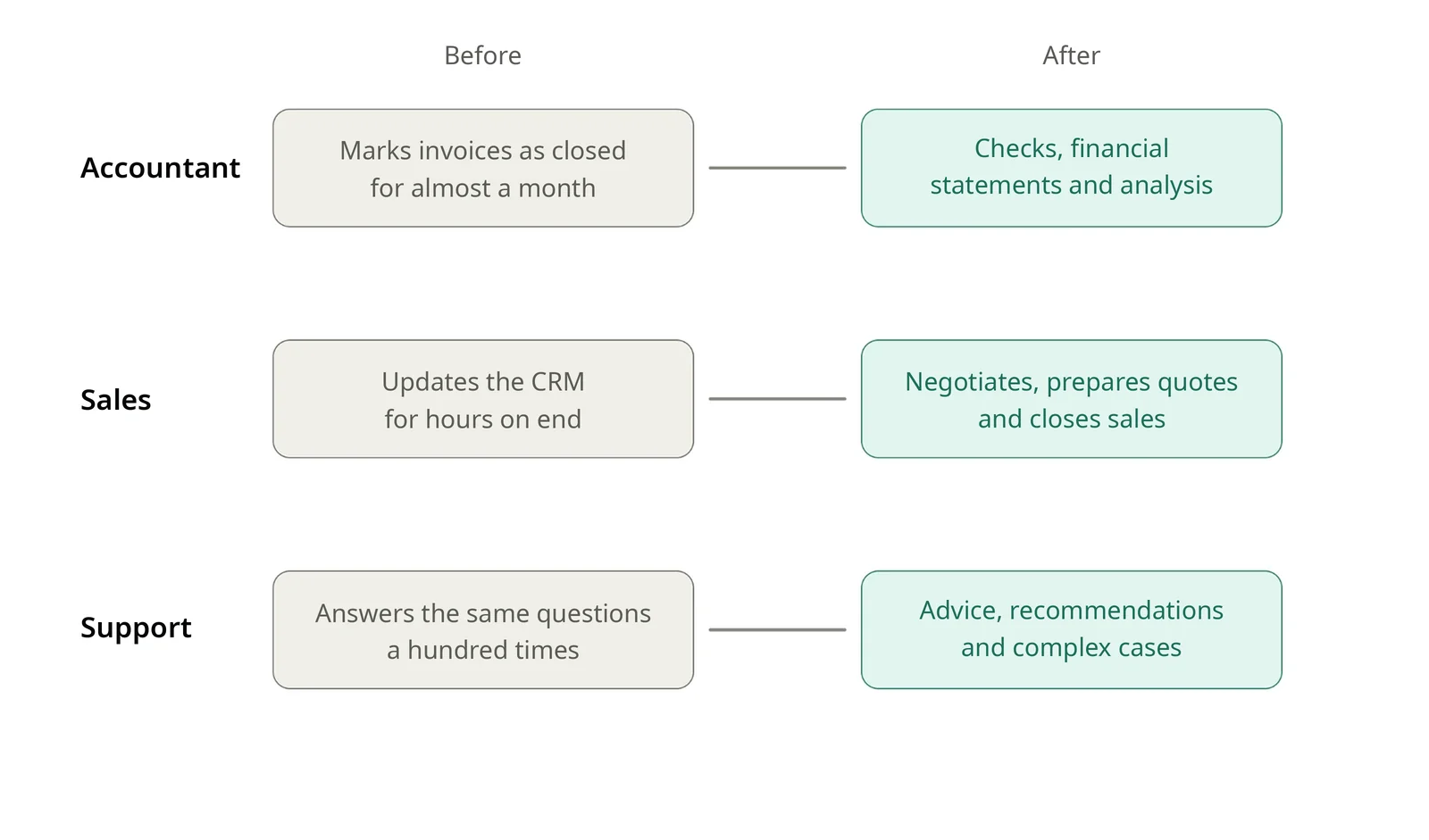
The accountant no longer marks invoices as closed in the accounting software (almost an entire month of work) or copies numbers from one spreadsheet to another - they get back to analysis and to the reports management uses to make decisions. The salesperson no longer spends hours filling in the CRM - they negotiate, send quotes and close deals, which is what you hired them to do. The support person no longer answers the same simple question a hundred times - they help the customers who need advice, the right recommendation or a way out of a more complicated situation.
You get back capacity you're already paying for but have been wasting on routine work. Same person, same salary, back to the work the company depends on.
That's exactly what happened at Aquator Transilvania. An accountant spent almost three quarters of the month marking invoices as closed in the accounting software. After an agent took over the invoice marking, the accountant had almost the whole month free for reviews, financial statements and analysis. We covered the whole story, with numbers, in the Aquator case study.
Want to see what could be automated in your company? Walk a Cicada specialist through a typical day at your company and find out where the opportunities are, with no commitment.
Frequently asked questions
How much does an employee doing repetitive work actually cost me?
The cost doesn't show up on any invoice. It's hidden in the salary. If a skilled employee costs you around 9,000 RON a month and three quarters of their time goes into repetitive work, you're throwing away around 6,750 RON a month on tasks that don't need their skills, which adds up to over 80,000 RON a year for one person. On top of that comes a cost that's harder to calculate but just as real: if the person loses motivation and leaves, replacing them costs between half and twice their annual salary.
Does automation mean I have to lay people off?
No, quite the opposite. An agent takes over the mechanical part of the job. It doesn't replace the person. The point isn't to cut people from the company but to stop keeping them stuck on work below their level. The person stays and handles what takes judgment and experience, which is the work you hired them for and are paying them to do.
How can I tell if I'm wasting my good people?
Look at what a day looks like for your most skilled people. If someone paid for their expertise spends most of their time copying data, filling in spreadsheets or answering the same questions, work that involves no decisions and that anyone could do, then you're paying for expertise and getting routine work.
If I'm paying the person anyway, why automate?
Because you're paying for their ability to create value, not for checking off mechanical tasks. Someone kept on routine work doesn't just produce less than they could. They also lose motivation and, over time, leave. When you free them from repetitive work, the same person, on the same salary, gets to do the work the company depends on. Instead of adding a cost, you make better use of one you already have.
What to remember
The most expensive thing in a company isn't the software, the rent or the equipment. It's the good people. And the quietest, most expensive kind of waste is keeping them busy with work anyone could do.
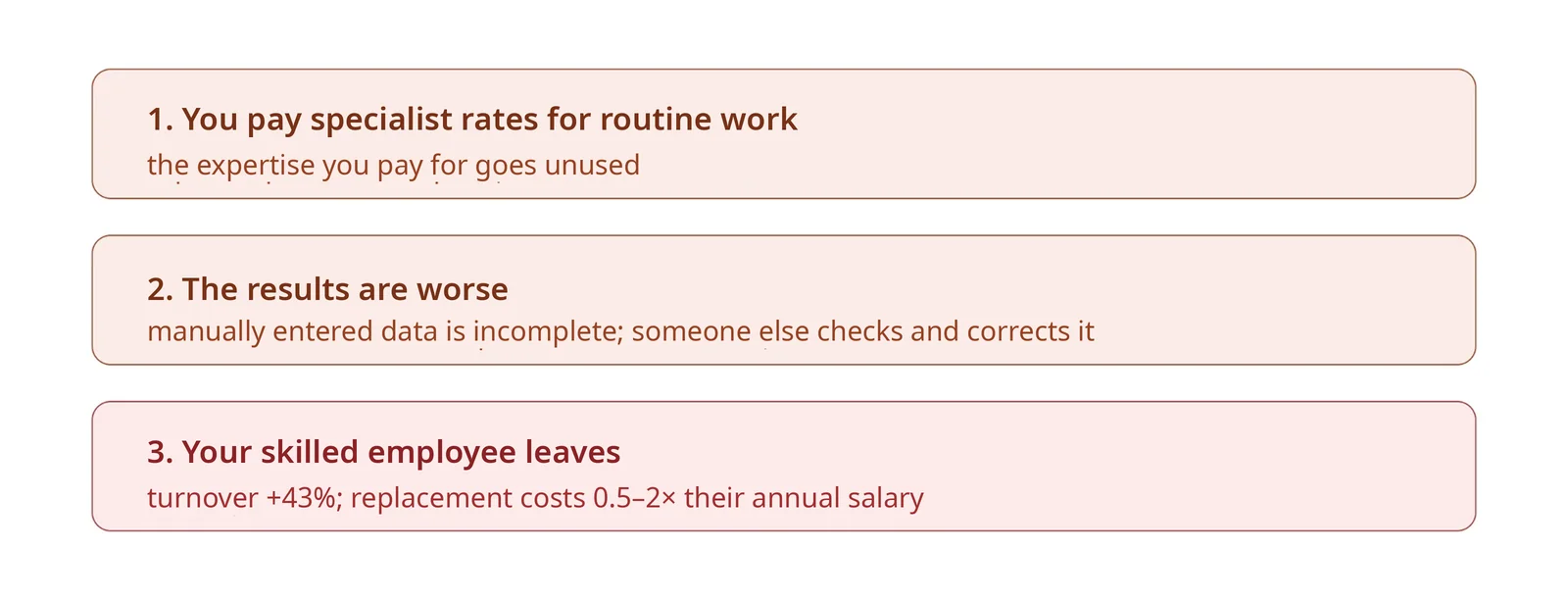
It hits you on three fronts at once. You pay specialist rates for routine work. You get weaker output from that work than you should. And over time you lose the very people you rely on, then pay heavily to replace them with others you put on exactly the same work.
The figure we started with, three quarters of people's time wasted on work with no value, hasn't changed in ten years. That tells you everything you need to know: the problem doesn't go away on its own, and one more hire won't solve it. It only gets solved when you take a hard look at what your good people do all day and decide to give them back the time you're paying for anyway.
If you want to see what repetitive work could be taken off your team's plate, fill out the form with a few details and we'll get back to you as soon as possible.
